
VHF radio system
18-site analog simulcast modernization; IP-based and P25 Phase 1 capable.
How one cross-functional RFP lead used a continuously audited AI work environment to multiply effective capacity across a 294-page, multi-million-dollar public-safety communications proposal while retaining human control of facts, system design, scope, pricing, contract positions and customer commitments.
The source set combined mission-critical radio infrastructure, alarm monitoring, legacy integration, construction, project delivery, pricing, compliance and federally funded public-works contract obligations.
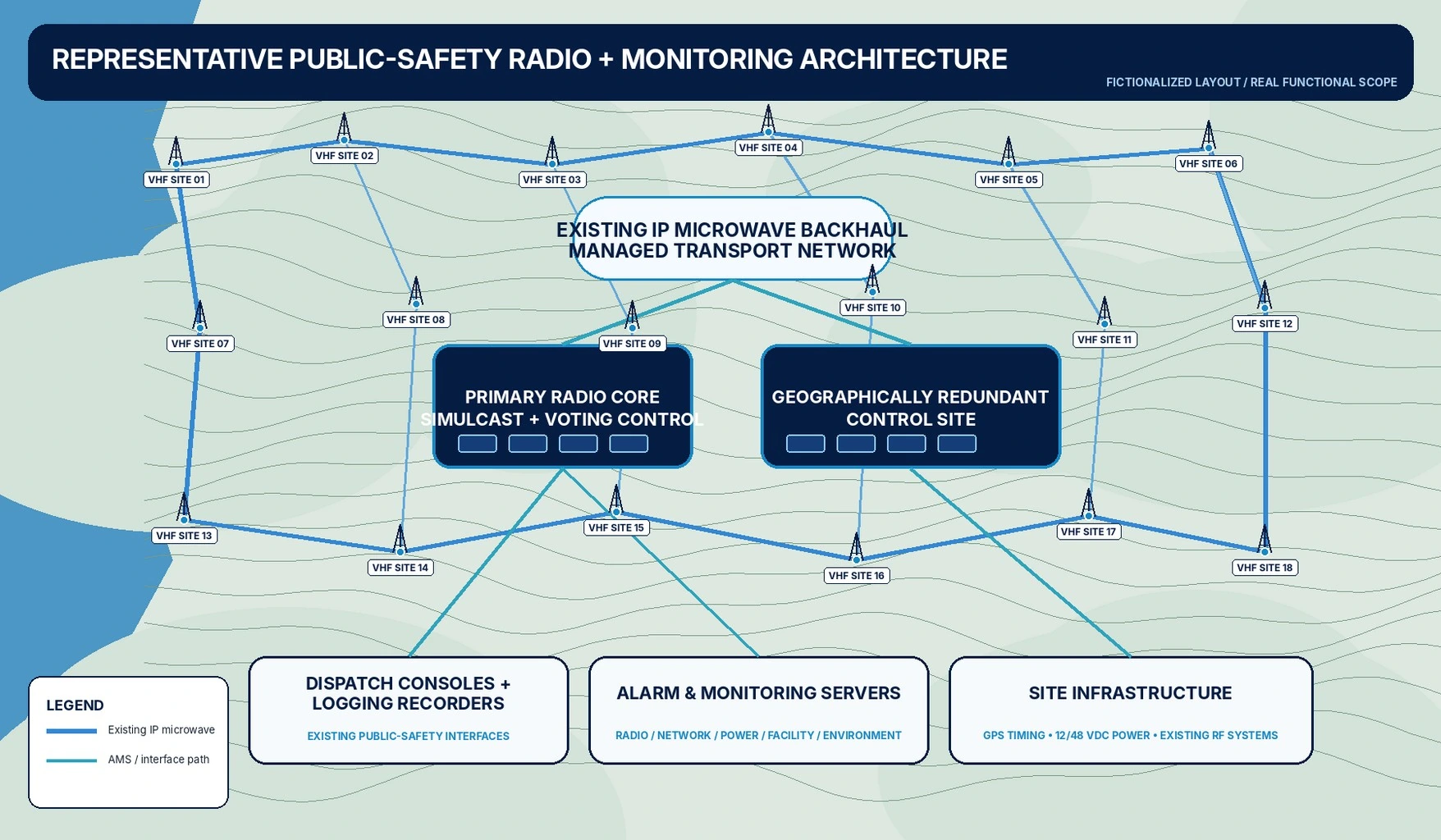
A county public-safety agency sought replacement of an 18-site analog VHF simulcast radio network with IP-based infrastructure capable of future P25 Phase 1 operation, plus a separate IP-based Alarm and Monitoring System (AMS). The RFP covered up to 95 base stations and required integration with existing IP microwave backhaul, dispatch consoles, logging recorders, GPS timing, 12/48 VDC site power, antennas, transmission lines, combiners, multicouplers and filters. The two systems shared sites, transport, power, schedule, pricing and implementation dependencies but required distinct designs, compliance responses and delivery plans.
18-site analog simulcast modernization; IP-based and P25 Phase 1 capable.
Radio, network, power, facility and environmental alarms.
IP microwave, dispatch, logging, GPS timing, site power and RF.
Staging, testing, channel cutover, training and acceptance.
Federal grant, bonding, prevailing wage, insurance and liquidated damages.
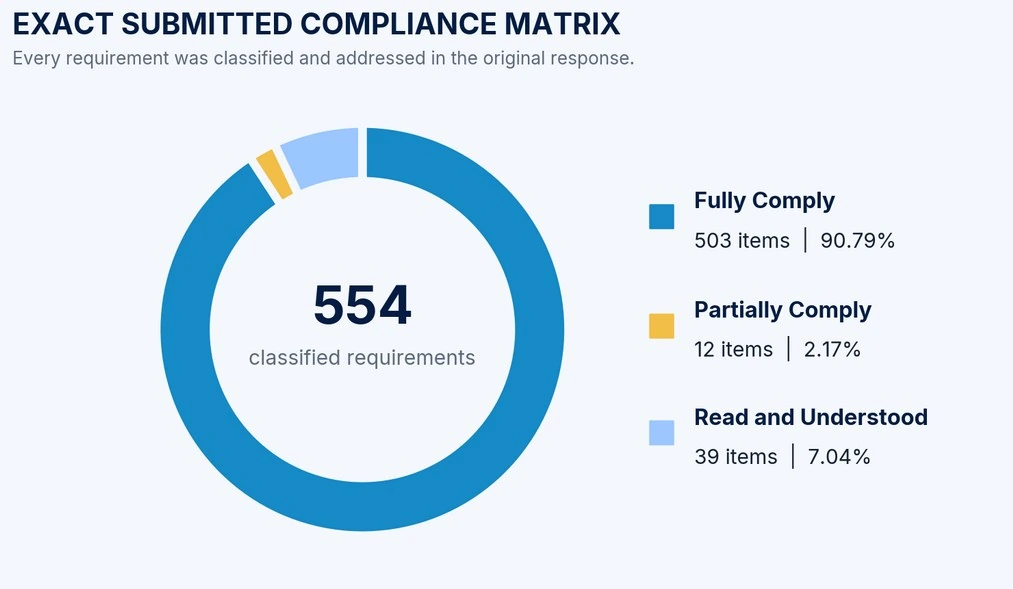
554 classified items across technical, commercial and contract scope.
Eight addenda plus interviews and coordinated post-bid revisions.
Multi-million-dollar proposal covering up to 95 base stations.
The existing public-safety radio channels could not be shut down during installation. The response required parallel deployment, staged testing, channel-by-channel cutover and rollback planning.
Existing IP microwave backhaul, dispatch consoles, logging recorders, GPS timing, 12/48 VDC site power, antennas, transmission lines, combiners, multicouplers and filters had to remain part of the solution.
The 294-page original RFP response included technical approach and project management, implementation staffing, work plan and Microsoft Project schedule, separate VHF and AMS technical proposals, a 554-line point-by-point compliance matrix, cost-control plan, detailed not-to-exceed pricing, public-works contract response, insurance, required forms, eight addenda and technical design attachments.
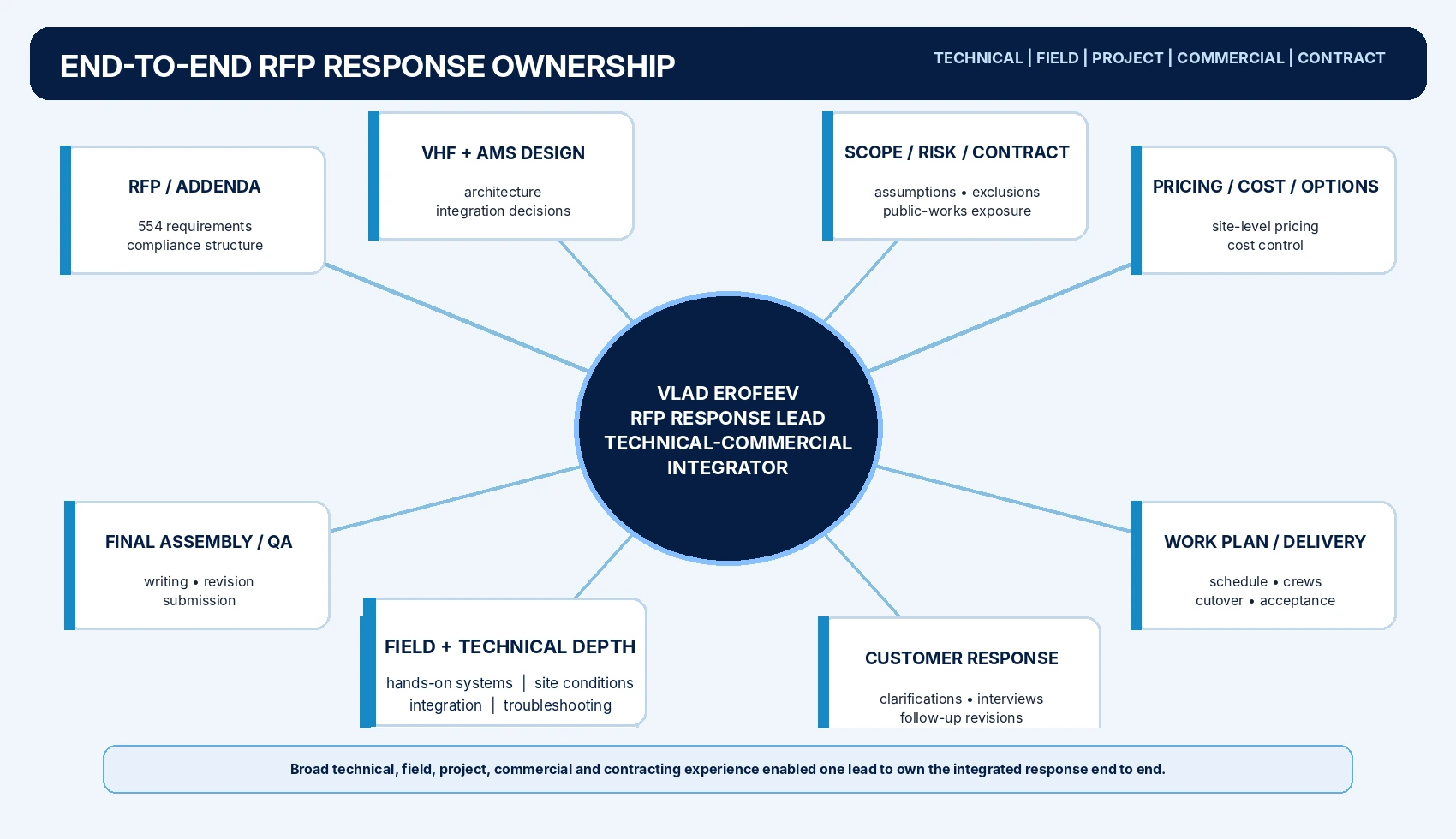
Vlad's nearly 25 years across hands-on field work, systems integration, engineering, project/program delivery, operations, presales, estimating, contracting and leadership enabled unusually broad end-to-end ownership.
Vlad personally produced, directed, reviewed and integrated the vast majority of the RFP response. He established the response architecture, performed requirements analysis, developed the integrated response strategy, made substantive internal decisions, integrated specialist inputs and carried final responsibility for scope, schedule, pricing integration, contract position, compliance narrative and customer response.
| Experience base | Relevant capability | RFP ownership enabled |
|---|---|---|
| Hands-on field + systems integration | Site conditions, installation, testing and troubleshooting | Grounded design, implementation, cutover and acceptance |
| Engineering + technical leadership | VHF/LMR, RF, IP microwave, dispatch and rack/power | Directed architecture, interfaces and integration decisions |
| Project/program delivery | Schedules, crews, dependencies, risks and acceptance | Built the work plan and executable delivery strategy |
| Presales + estimating | Equipment, labor/services, options, pricing and cost control | Integrated the multi-million-dollar commercial response |
| Contracting + commercial management | Public works, bonding, wage, insurance, change and liability | Owned assumptions, exclusions, contract position and risk |
| Proposal/RFP leadership | Requirements, narrative, addenda, compliance and QA | Structured the 294-page response and 554-line matrix |
| Customer + executive communication | Clarifications, interviews and revisions | Owned customer response and final narrative |
Vlad's combined technical, field, project, commercial, contracting and customer experience allowed him to test each decision across the full delivery chain - technical feasibility, cost, schedule, risk, implementation and customer commitments - before it entered the response.
The original development chat did not survive. The operating model below is reconstructed from surviving project records, later evaluation work and direct project recollection; it is not presented as a verbatim transcript.
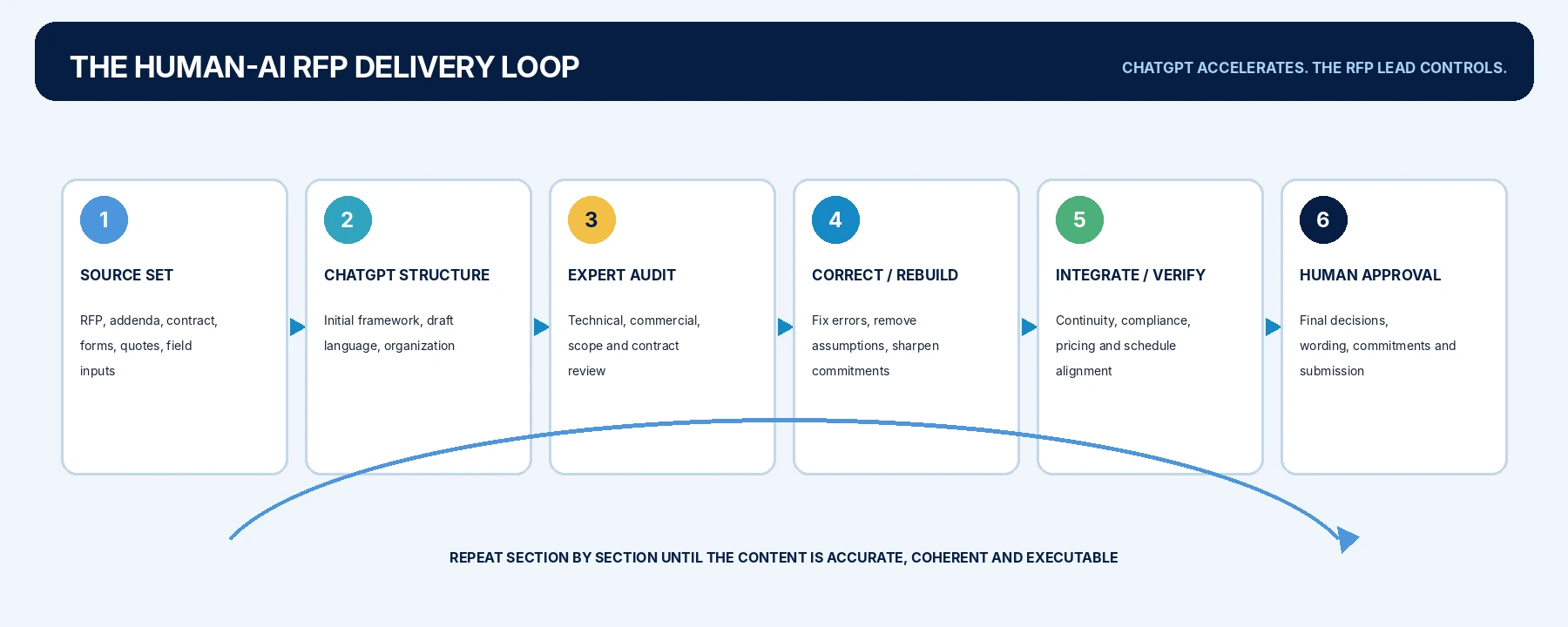
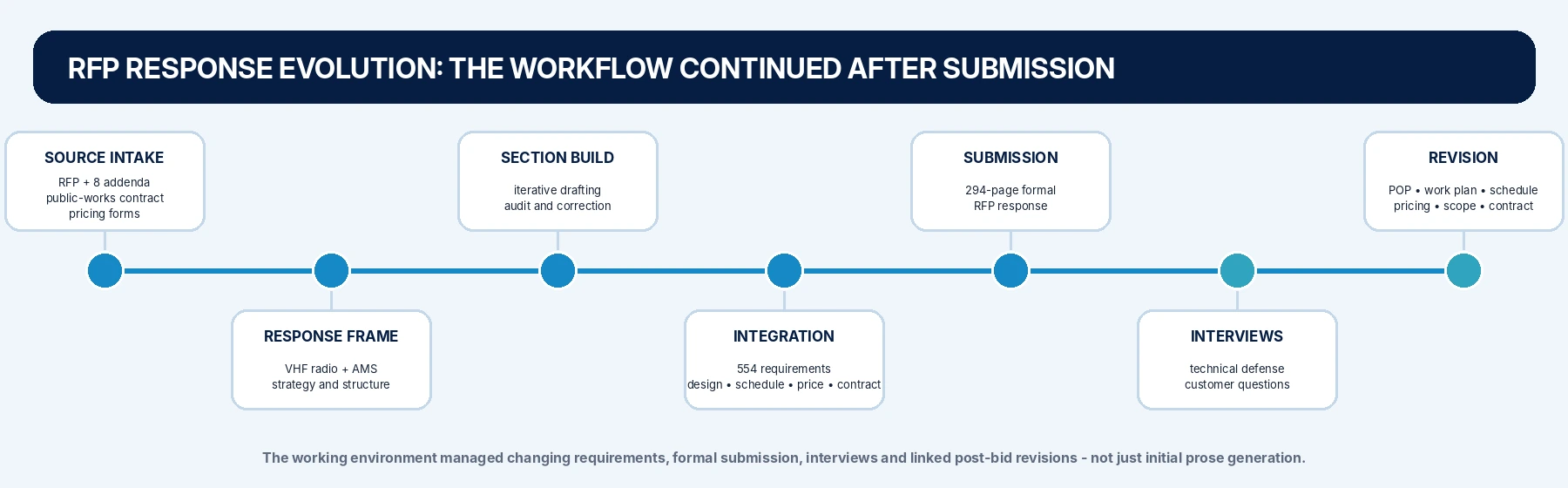
The initial phase established the overall response and solution strategy. Work then shifted to a section-by-section loop: provide RFP sources and technical direction, generate a draft, audit it, correct technical, commercial or contract errors, and reintegrate the section. The process repeated until acceptable.
| Workstage | Controlled application |
|---|---|
| Source intake | RFP, scope, eight addenda, official Q&A, price forms, federally funded public-works contract documents, technical inputs, quotes and site observations. |
| Response + solution architecture | Response order, VHF and AMS strategy, compliance structure, major risks, open questions and customer commitments. |
| Section production | Technical approach, project management, work plan/schedule, VHF and AMS technical proposals, 554-line compliance matrix, cost control, pricing and contract response. |
| Expert audit | Fact checking, engineering feasibility, integration, scope boundaries, pricing exposure, public-works contract risk and customer-facing wording. |
| Cross-document integration | Consistency among narrative, compliance matrix, equipment lists, schedule, pricing, assumptions, drawings and post-submission revisions. |
| Customer follow-up | Interview preparation, revised work plan, Microsoft Project schedule, updated pricing, scope clarifications, technical summaries and contract position. |
Accelerated source organization, response structure, drafting, reframing, requirement handling, continuity and revision. It provided one persistent work environment around the RFP rather than isolated prompts.
Model quality and context handling were materially weaker than current systems. Fluent output could still be technically wrong, commercially risky, incomplete or overly confident. Most substantive sections required iterative expert review and correction, often through multiple passes.
The leverage came from how Vlad operated, challenged and controlled the AI work environment. Draft generation increased throughput; expert review, correction and final human approval controlled the result.
The methodology was already iterative and human-controlled. What improved afterward was operating discipline: more precise source instructions, stronger context transfer, better contradiction checks and faster recognition of plausible but bad material.
| Used during the RFP | Lesson exposed | Strengthened through experience |
|---|---|---|
| Repeated audit and correction | Plausible language can still be wrong | More precise source instructions and fact/assumption separation |
| Section-by-section production | Cross-section drift grows with scale | Deliberate contradiction and cross-document consistency passes |
| Document checks and short SME calls | Context gaps can remain | Better project-state summaries, context transfer and verification prompts |
| Final human approval | AI fluency is not authority | Stronger challenge routines, including outside the operator's deepest specialty |
The work included design and integration of an 18-site VHF simulcast/P25-capable radio system and a separate AMS, plus rack and power planning, testing, cutover, project delivery, pricing and public-works contract exposure.
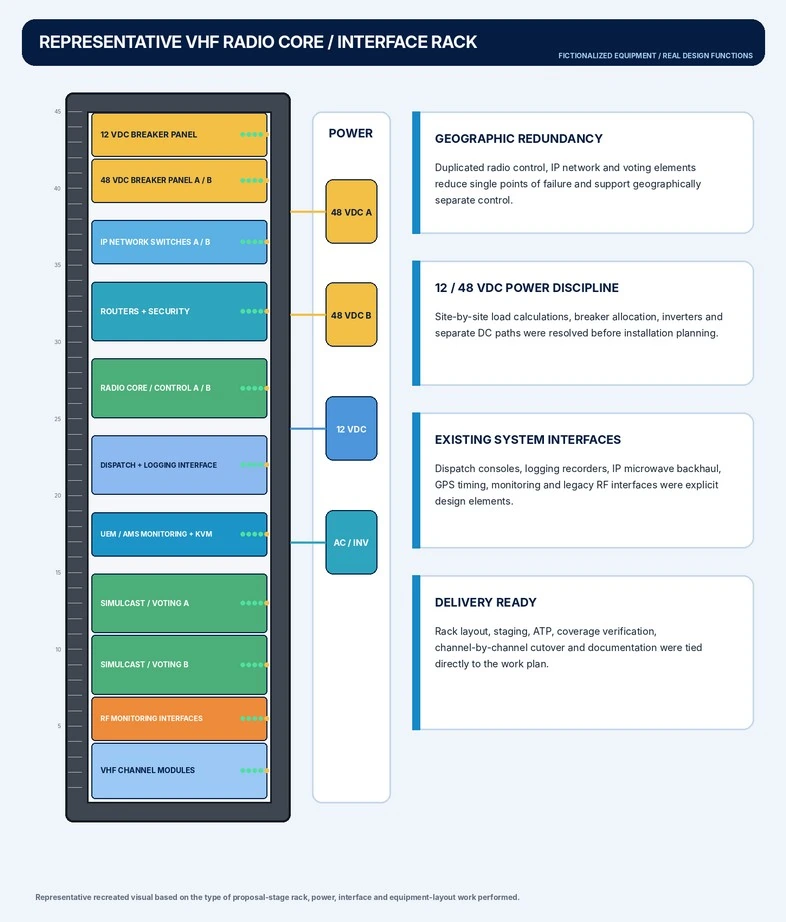
Vlad directed the proposal-stage system, interface and rack-design work, made the substantive decisions, reviewed and revised the artifacts, and held final internal authority over what entered the RFP response. His role connected technical design with scope, pricing, contract commitments and delivery planning.
After submission, the public-safety agency compressed the period of performance and required coordinated changes across scope, schedule, pricing, risk, contract position and interview materials.
Vlad produced and coordinated an interview presentation, revised work plan, detailed Microsoft Project schedule, updated pricing workbook, VHF/AMS scope clarifications, monitoring summary, technical support material and a revised liquidated-damages position. The original response remained intact; the revision package expressly superseded conflicting schedule, pricing and assumption language.
Manufacturing assumption reduced from 90 to 50 days; staging from 30 to 25; at least three parallel crews; site work re-sequenced.
Removed the broad AMS implementation from the committed period of performance while preserving core radio-system monitoring and a post-award delivery path.
Early equipment ordering at integrator risk; updated travel/labor allowances; winter-access exclusions; optional pricing for ambiguous repeater scope.
Interview presentation and technical summaries connected architecture, compliance, pricing, maintenance, schedule and contract position.
The strongest applied-AI evidence is not the volume of the first submission. It is the ability to absorb changed RFP conditions, preserve version control, identify superseded statements, revise multiple linked artifacts and maintain one coherent engineering, pricing, contract and delivery position through interviews and follow-up.
The project was an early large-scale experiment, not the finished state of the methodology.
The fundamental loop is unchanged: establish the source set, generate, audit, correct, verify and integrate. AI remains a high-throughput reasoning and production environment; the RFP lead remains accountable.
Stronger project instructions, source discipline, context transfer, verification, contradiction checking and recognition of plausible but bad material - including subjects outside the operator's deepest specialty.
The most dangerous output often sounds professional and complete.
A lead who understands VHF/LMR, field, project, pricing and contract consequences can correct the whole system of work.
Requirements, addenda, contracts, vendor confirmation and project facts remain the authority.
Pricing, scope, engineering decisions, contract positions and customer promises require human approval.
A useful AI environment maintains continuity through addenda, interviews, revisions and delivery planning.
It was that one experienced cross-functional RFP lead could use ChatGPT to multiply effective capacity across a mission-critical public-safety communications pursuit while preserving technical truth, executable commitments and final human accountability.
Long before AI, the same cross-functional ownership appeared in solution architecture, software development, systems integration, installation and field support, wireless infrastructure, troubleshooting and operational ownership.
Use the concise web page for the main story, or download either rebuilt public PDF.
The next step can be structured around the actual source material, required output, technical environment, timing, and the level of ownership needed.