
Public case study | Representative experience

AI-Assisted Delivery of a Complex Public-Safety Communications RFP Response

Mission-Critical Public-Safety Communications Modernization. A county public-safety agency issued a multi-million-dollar RFP to modernize an 18-site analog VHF simulcast radio network with IP-based, P25 Phase 1-capable infrastructure and deploy a separate IP-based Alarm and Monitoring System (AMS). The response had to coordinate up to 95 base stations, existing system interfaces, pricing, compliance, contracts and customer follow-up in one coherent package.

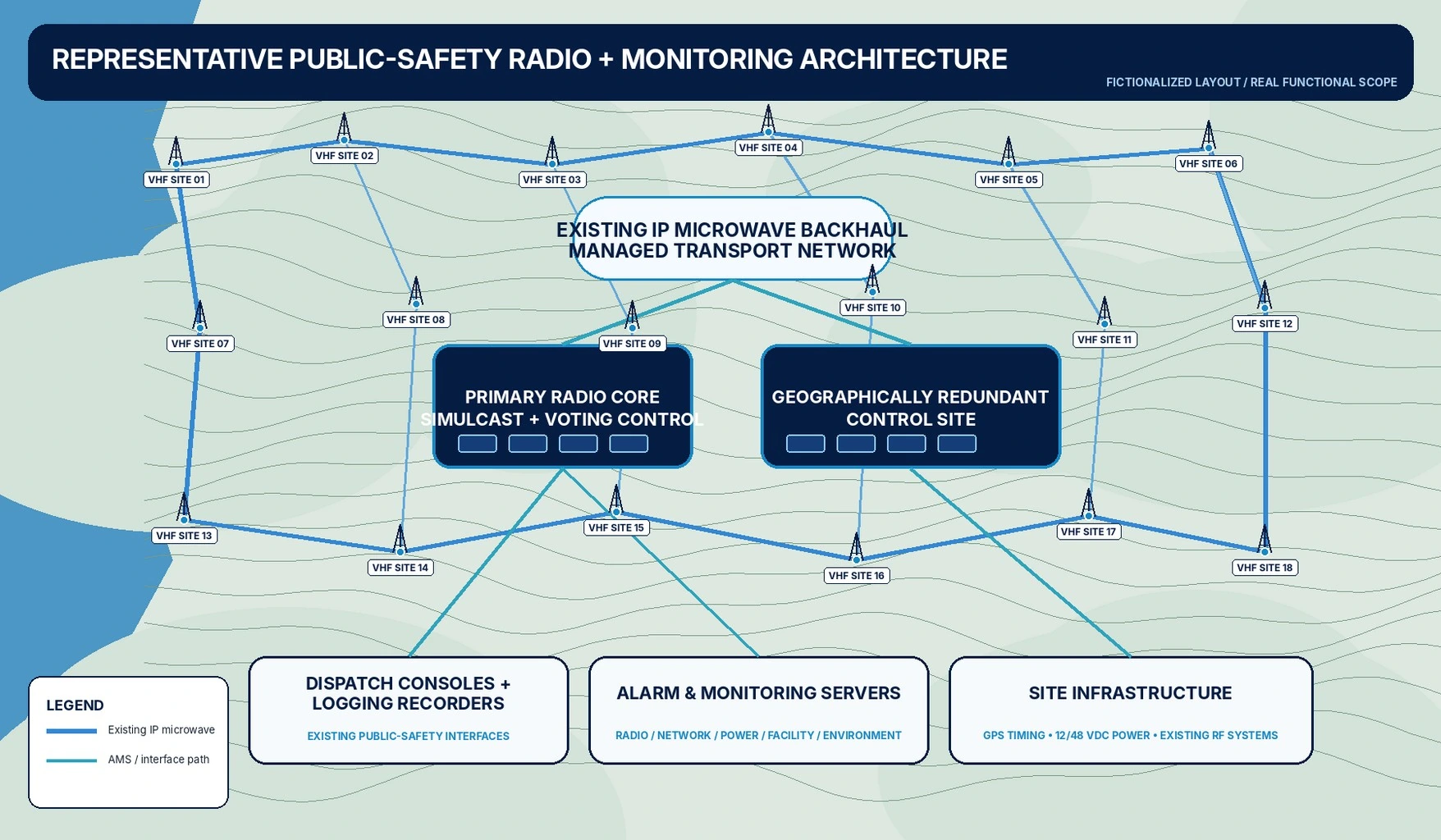
Representative public-safety radio and monitoring architecture
Representative public-safety radio and monitoring architecture - all labels, site layout and equipment are fictionalized.
294Page original response
554Requirements classified100% classified and addressed
92.96%Fully / partially comply
7.04%Read & understood
Representative experience based on prior professional work led by Vlad Erofeev while employed by a communications systems integrator. Customer, employer, vendor and contributor names have been withheld, and all technical visuals have been recreated with fictionalized labels and layouts. VERO Consulting was not the bidder or contracting entity.
The public-safety RFP

An 18-site public-safety radio modernization with no clean departmental boundaries.

The source set combined mission-critical radio infrastructure, alarm monitoring, legacy integration, construction, project delivery, pricing, compliance and federally funded public-works contract obligations.

The challenge

Existing public-safety radio channels had to remain live through parallel installation, staged testing, channel-by-channel cutover and rollback. New equipment had to integrate with existing IP microwave backhaul, dispatch consoles, logging recorders, GPS timing, 12/48 VDC power and RF infrastructure. Eight addenda changed quantities, requirements, pricing forms and implementation assumptions. The response also had to address bonding, prevailing wage, insurance, acceptance and liquidated-damages requirements.
End-to-end RFP ownership

Vlad personally produced, directed, reviewed and integrated the vast majority of the RFP response. Drawing on nearly 25 years across field service, systems integration, engineering, project/program delivery, presales, estimating, contracting and operations, he made the substantive internal decisions and owned the proposed technical architecture, scope, schedule, pricing integration, contract position, compliance narrative and customer response.

Operating model

One cross-functional RFP lead. One continuously audited AI work environment.

AI accelerated throughput and continuity; human expertise remained the control system.

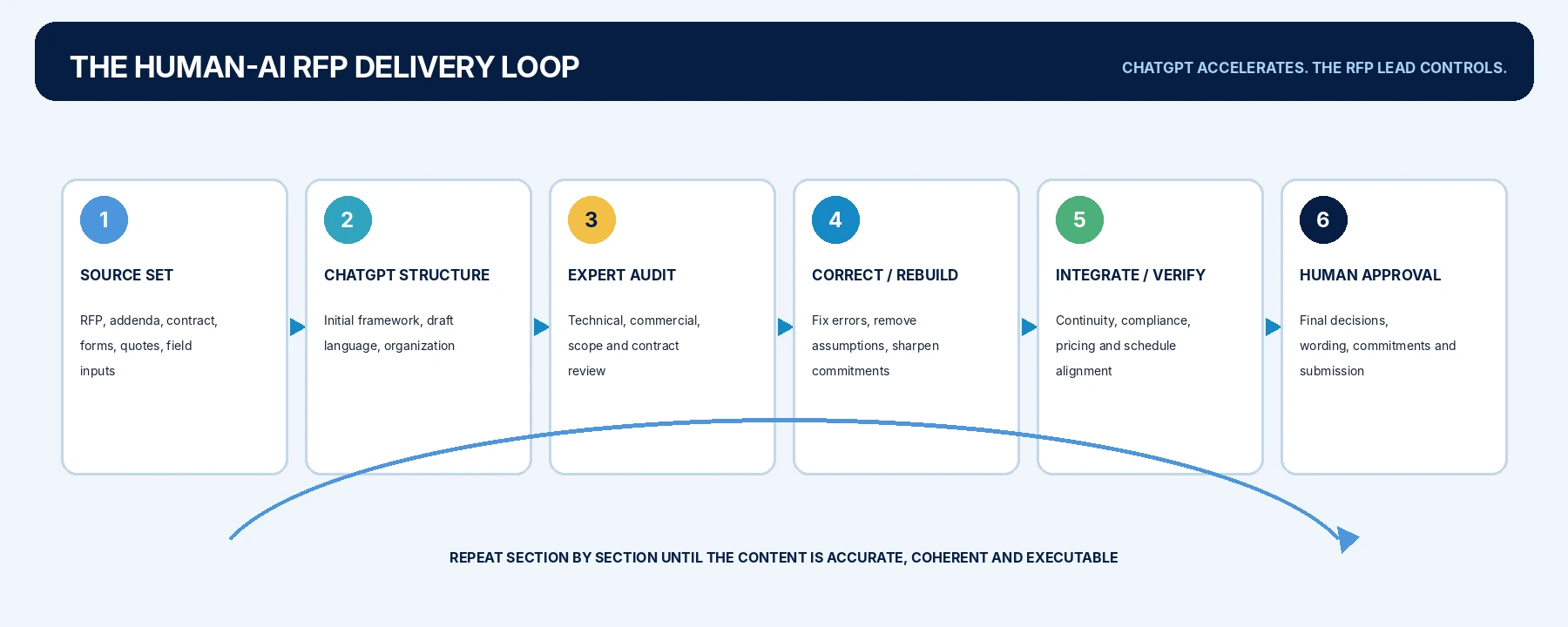
Six-stage human-AI RFP delivery loop
Source set → ChatGPT structure → expert audit → correct/rebuild → integrate/verify → human approval.

The method was simple and demanding: load RFP sources and technical direction, generate an initial structure or draft, audit it against engineering reality, compliance obligations and commercial risk, correct it, and repeat section by section until acceptable.

AI-assisted

  • RFP/addenda intake, requirements organization and compliance drafting
  • Technical, project, commercial and contract draft development
  • Cross-document checks, interview preparation and revision support

Human-owned

  • Facts, system design, engineering and compliance judgments
  • Scope, pricing, public-works contract position and vendor confirmation
  • Customer commitments, final wording, approval and submission
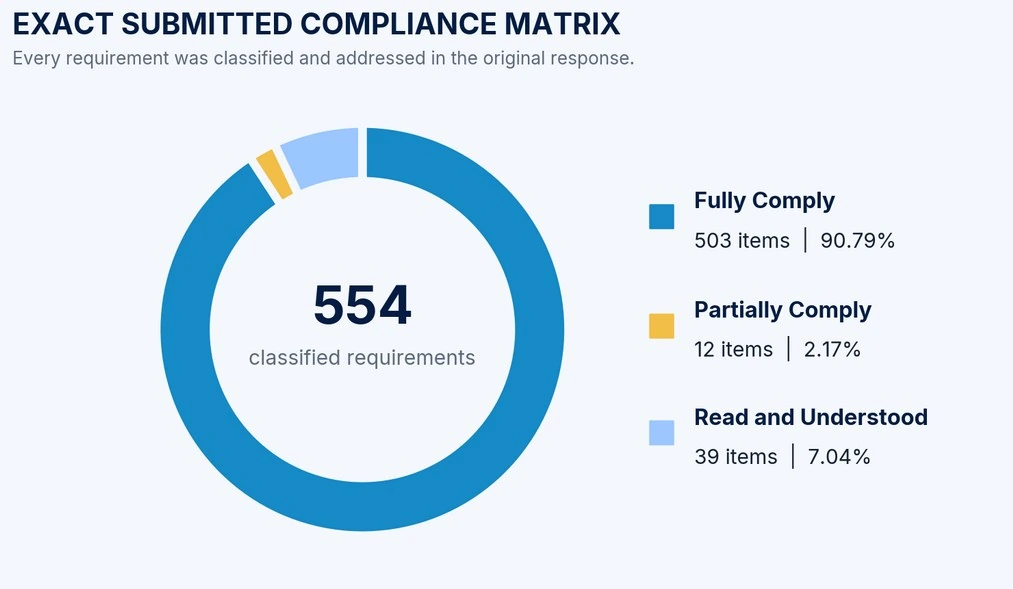
Compliance classification chart showing all 554 requirements addressed
503 Fully Comply, 12 Partially Comply and 39 Read and Understood - every requirement classified and addressed.
What this demonstrated

The accomplishment was not that AI “wrote 294 pages.”

It was that one senior cross-functional RFP lead used AI across work normally divided among proposal management, systems engineering, project management, estimating/pricing, contracts, document production and customer response - without surrendering accountability. The response was submitted, defended in interviews and revised when the customer compressed the period of performance and changed scope.

“AI multiplies capability only when the person operating it can recognize what is wrong, incomplete, risky or impossible.”

Supporting detail

Want the full public-safety RFP breakdown?

The 8-page supporting case study expands the 18-site system context, actual ownership model, continuously audited AI workflow, 554-requirement compliance discipline, integrated engineering, pricing, contract and delivery depth, post-submission adaptation and transferability to other complex work.

Original public artifacts

Read the source case-study documents.

The web pages are designed for fast reading. The PDFs preserve the rebuilt public brief and supporting-detail layouts.

2 PAGE

Public Case Study Brief

Concise overview of the 18-site modernization, RFP scale, end-to-end ownership and human-AI operating model.

Download PDF
8 PAGE

Public Supporting Case Study

Detailed evidence covering system scope, actual ownership, controls, integrated engineering, pricing, contract and delivery depth, and adaptation after submission.

Download PDF
Apply the capability

Need similar ownership across a difficult technical pursuit or delivery problem?

I can support a complete response, technical volume, specification, design and equipment package, independent review, or pursuit-to-delivery assignment in a role, contract, or consulting structure.